
EDEXCEL A LEVEL ECONOMICS NOTES - 2.1 Measures of economic performance
a) Rates of change of real Gross Domestic Product (GDP) as a measure of economic growth
b) Distinction between:
o real and nominal
Real GDP: Measures total output adjusted for inflation
Nominal GDP: Is total output without adjustments for inflation
o total and per capita
Total GDP: Total output produced in a country.
GDP Per Capita: The total output/population.
c) Other national income measures:
o Gross National Income (GNI)
Measures the total income earned by a country’s residents, including income from abroad.
GNI = GDP + net income from abroad
- Income from abroad:
- Profits from overseas investments
- Wages earned abroad
d) Comparison of rates of growth between countries and over time
Comparison of rates of growth (between countries and over time):
- Economic growth is measured using percentage change in real GDP (volume)
Between countries:
- Compare how fast different economies are growing
- Higher growth rate → faster increase in output and living standards
- Useful for:
- Identifying emerging economies (e.g. faster growth than developed countries)
- However:
- Differences in population growth can distort comparisons
- Exchange rates and data reliability may vary
e) Understanding of Purchasing Power Parities (PPPs) and the use of PPP-adjusted figures in international comparisons
PPP: Purchasing Power Parity PPP is a theory that suggests that exchange rates are in equilibrium when they have the same purchasing power in different countries.
For example: Suppose a Big Mac costs £2 in the UK and $4 in the US. The correct exchange rate according to purchasing power parity would by £1 equals $2. This would leave a customer indifferent to buying the good in the UK and buying it in the US
Currency is overvalued or undervalued
- e.g. if £1 = $3 → pound overvalued (using example above)
f) The limitations of using GDP to compare living standards between countries and over time
- Does not include informal / black market activity
→ Understates true economic activity - Ignores environmental costs
→ Growth may cause pollution and resource depletion - Does not measure quality of life
→ Excludes happiness, human rights, freedom - Ignores inequality
→ GDP may rise but living standards may not improve for all - No indication of how income is used
→ Growth could be spent on military rather than:Education Healthcare
→ Different impacts on development and human capital
g) National happiness:
- Focuses on wellbeing and quality of life, not just income
- Recognises GDP ≠ happiness
o UK national wellbeing
Measured by surveys (ONS) using:
- Life satisfaction
- Happiness
- Anxiety
- Feeling life is worthwhile
→ Gives a broader measure of living standards
o The relationship between real incomes and subjective happiness
- Higher real income → increases happiness up to a point
- After basic needs are met → diminishing returns to happiness
a) Understanding of:
o inflation
Definition: Sustained increase in the general price level.
- In the UK, it is usually sustained at around 2% level.
- Inflation rate: Increase in price level in percentage terms.
o deflation
Definition: Fall in the general price level
For example the inflation rate will be negative at -3% --> prices falling by 3%.
o disinflation
Definition: Prices are rising, but at a slower rate than before.
For example, if the inflation rate was 2% in 2023, and 1% in 2024, there is still a price rise in both years, so there is still inflation. Price is just rising at a slower rate, so it's called disinflation.
For example, if inflation is 2% in 2023 and falls to 1% in 2024, prices are still rising in both years. However, they are increasing at a slower rate, which is known as disinflation.
b) The process of calculating the rate of inflation in the UK using the Consumer Prices Index (CPI)
CPI (Consumer Price Index):
- Uses a household expenditure survey to give different goods a weighting based on importance in the average basket
- Prices of these goods are measured monthly to track changes
- These changes are combined into an index by applying weights to price changes to calculate overall inflation
c) The limitations of CPI in measuring the rate of inflation
- Not representative for all householdsBasket of goods is based on an average householdDifferent groups (rich/poor) have different spending patterns
- Fixed basketsCPI assumes fixed basketConsumers may switch to cheaper alternatives when prices rise
- Quality changes not fully capturedImprovements in goods (e.g. phones, cars) may overstate inflation
- New goods problemCPI basket is updated slowlyMay miss new products and changing consumption patterns
- Regional differencesPrices vary across the UK but CPI is a national average
d) The Retail Prices Index (RPI) as an alternative measure of the rate of inflation
Key difference vs CPI:
- RPI includes housing costs and uses a different method
- CPI excludes mortgage interest payments and uses a more modern calculation method
e) Causes of inflation:
o demand pull
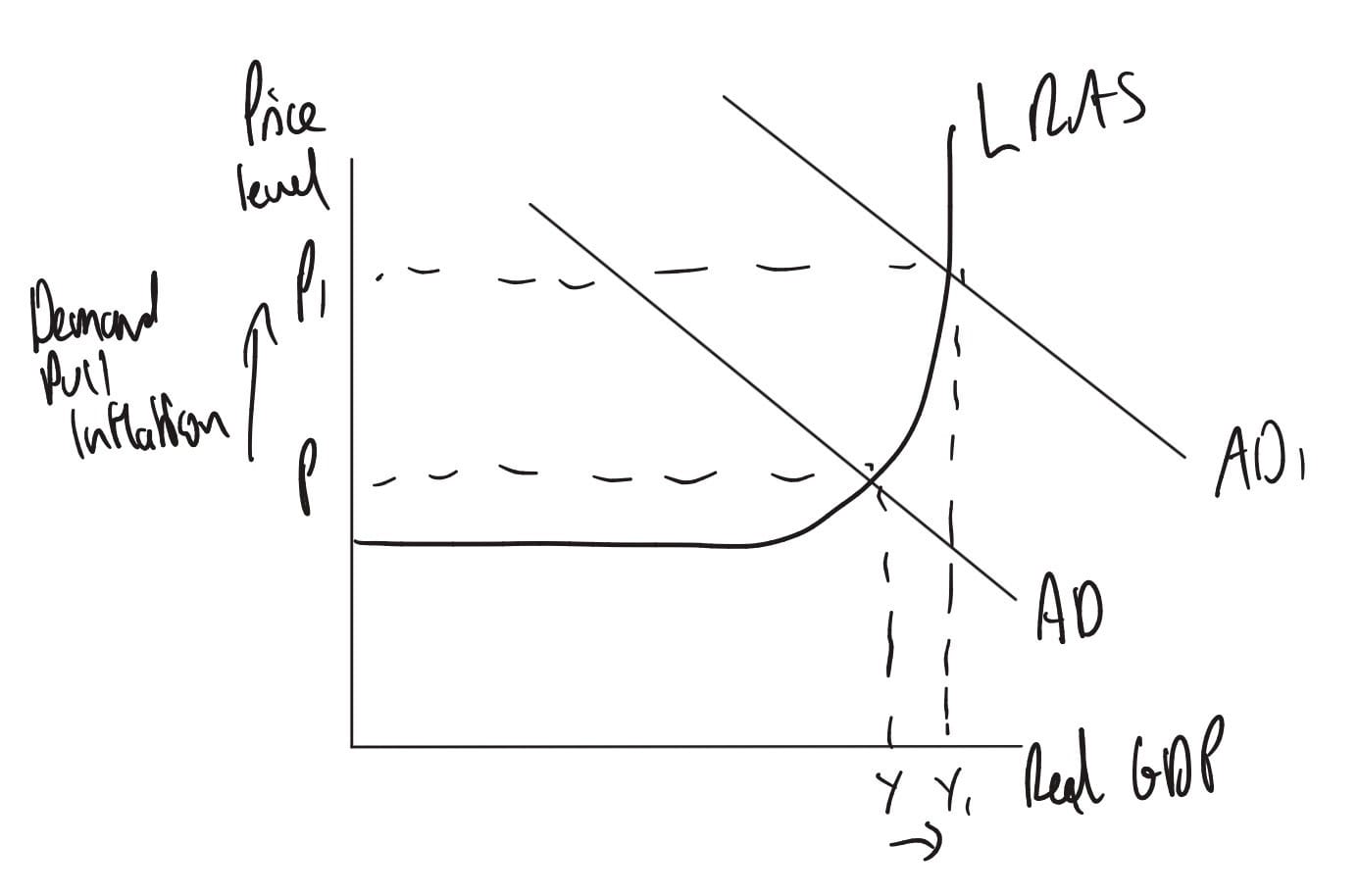
This occurs when aggregate demand (AD) rises as the economy approaches full capacity (LRAS).
AD → AD1 → output approaches full employment → spare capacity falls
As the economy becomes overheated, there are limited resources available, so firms cannot increase output easily. Instead, they respond by raising prices, causing the price level to rise from P to P1.
Since higher AD leads to a higher general price level, this is known as demand-pull inflation.
AD ↑ (AD to AD1) → output near capacity → scarcity of resources → price level ↑ (p to p1) → demand-pull inflation
o cost push
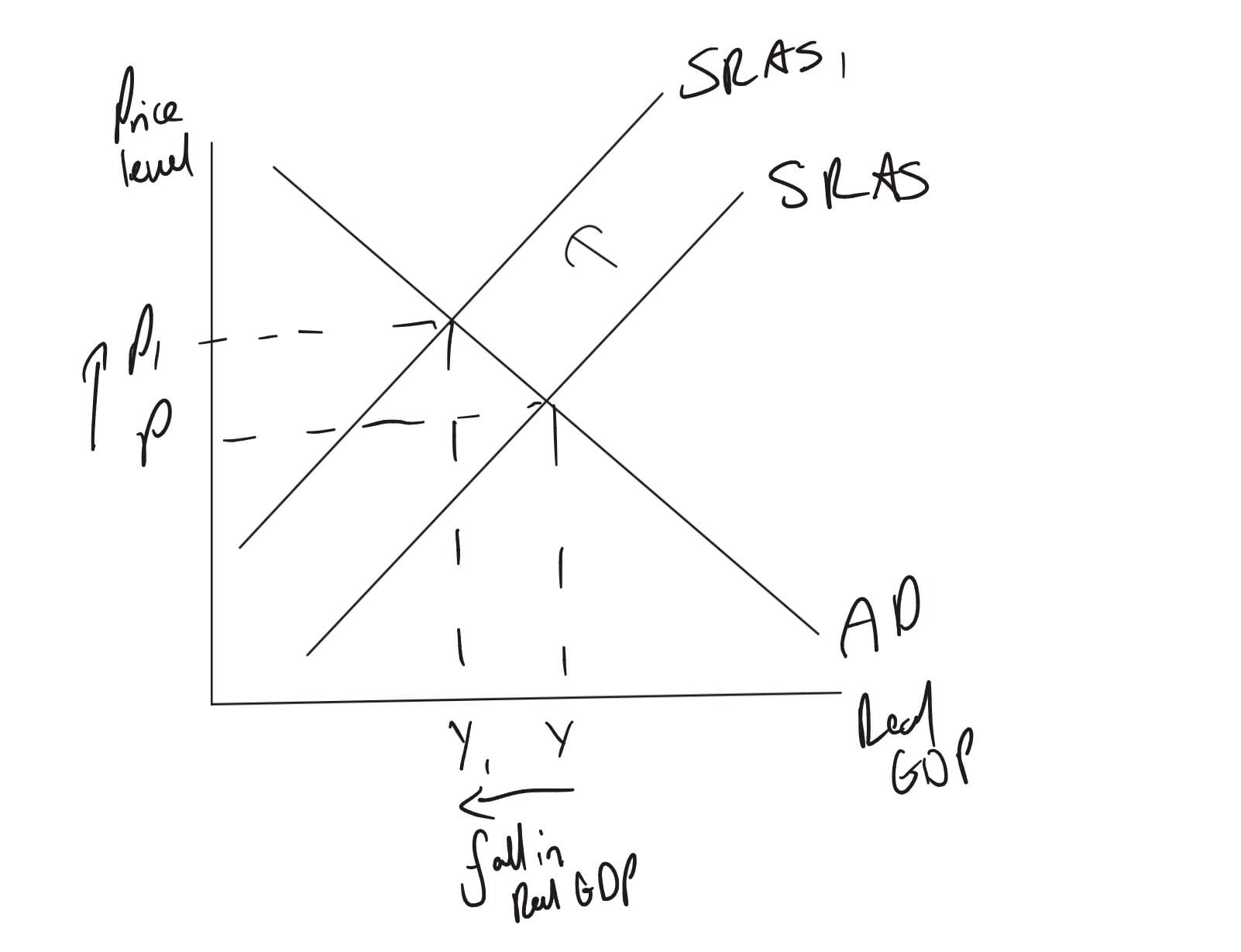
This is when firms pass higher costs onto consumers → higher prices.
On an AD/SRAS diagram:
↑ costs of production → SRAS shifts left (SRAS to SRAS1) → price level ↑ (from P to P1) (inflation) --> Fall in real GDP from Y to Y1.
Other causes of cost-push inflation (arrow chains):
- Poor technology → lower efficiency → higher unit costs → SRAS shifts left → inflation ↑
- Higher wages → higher production costs → SRAS shifts left → inflation ↑
- Higher interest rates → higher borrowing costs → higher costs for firms → SRAS shifts left → inflation ↑
- Higher corporation tax → lower after-tax profits → higher effective costs → SRAS shifts left → inflation ↑
- Lower exchange rate → imports more expensive → higher input costs → SRAS shifts left → inflation ↑
o growth of the money supply
- The money supply is the amount of money in circulation.
- This includes notes, coins and bank deposits.
- If the government printed more money, then there would be an increase in cash in the economy. Households will therefore have more money so their demand for goods and services would increase.
Therefore, increasing the money supply faster than output growth will cause inflation. This is because money will be chasing goods, so the demand will cause firms to put up prices.
f) The effects of inflation on consumers, firms, the government and workers
Costs of inflation:
- Higher prices → low-income households worse off → fall in real wages → lower purchasing power → lower standard of living
→ may reduce consumption → AD ↓ → investment ↓ → growth ↓ → employment ↓ - Higher inflation → reduced international competitiveness → exports become more expensive → exports ↓
→ AD ↓ + worse balance of payments + employment + growth - Wage–price spiral:
inflation ↑ → workers demand higher wages → firms’ costs ↑ → prices ↑ again → inflation accelerates - May lead to higher interest rates (to control demand-pull inflation)
→ higher borrowing costs → possible crowding out of private investment --> lower investment in tech for example --> poorer quality products/higher prices due to inefficiency --> reduce international competitiveness --> fall in exports --> worsen current account and balance of payment position - Higher government spending pressure (pensions + benefits rise with cost of living)
→ cause/worsen fiscal deficit –> debt --> uncertainty --> fall in consumer and business confidence --> consumption and investment falls.
Benefits of inflation:
- Asset prices may rise → wealth effect → higher consumer confidence → consumption ↑ → AD ↑
- Expectations of rising prices → consumers spend earlier → consumption ↑ → firms’ revenue & profits ↑ → investment ↑
Evaluation points:
- Depends on inflation rates in other countries → competitiveness may not worsen if rivals also have high inflation
- Depends on speed of inflation → high/accelerating inflation increases uncertainty → consumption + investment ↓
- Depends on cause:
- Cost-push inflation = worse (↓ output + ↑ prices)
- Demand-pull inflation = less damaging (↑ output)
- Depends on wage adjustment → if wages rise in line with inflation → real incomes may not fall
2.1.3 Employment and unemployment
a) Measures of unemployment:
o the claimant count
- Measures the number of people claiming unemployment related benefits, such as Jobseeker’s Allowance or Universal Credit (where relevant unemployment conditions apply).
- Useful because it is collected regularly and provides up to date monthly data.
- However, it underestimates unemployment because not all unemployed people are eligible to claim benefits or choose to claim.
o the International Labour Organisation (ILO) and the UK Labour Force Survey
- Based on a survey of households using the ILO definition of unemployment.
- A person is unemployed if they are without a job, available to start work within two weeks, and have actively looked for work in the last four weeks.
- However, it is based on estimates from surveys, so results may be less precise and subject to revision.
b) The distinction between unemployment and under-employment
- Unemployment refers to people who are willing and able to work, but cannot find a job.
- Under-employment refers to people who are employed, but not being fully utilised in the labour market.
- This may include workers who:want more hours than they currently receive (part time workers wanting full time jobs)are overqualified for their roleare working below their skill level
- They are counted as employed in official statistics, even though their labour is not fully used.
c) The significance of changes in the rates of:
o employment
- Measures the proportion of working age people in employment.
- A rising employment rate suggests stronger labour demand, higher output, rising incomes, and improved living standards.
o unemployment
- Measures the proportion of the labour force without a job but actively seeking work.
- A rising unemployment rate suggests weaker aggregate demand, lower output, and wasted resources.
o inactivity
- Measures the proportion of working age people not in work and not actively seeking work.
- Includes students, carers, long term sick, early retirees, and discouraged workers. A rising inactivity rate reduces the available labour supply and potential output.
- It may also increase dependency ratios and pressure on public finances.
- However, some inactivity such as education may improve future productivity.
d) The causes of unemployment:
o structural unemployment
- This occurs when there is a mismatch between supply and demand. This is caused by occupational or geographical immobility.
- Occupational: Workers may want to work, but there is a lack of demand for them due to their lack of skills.
- Geographical: The demand for workers is high, but there is limited supply of workers as they cannot commute or locate close to the job, hence they are unable to work.
o frictional unemployment
- Frictional unemployment is unemployment that occurs when people are temporarily between jobs or searching for a new job.
- It is caused by the normal movement of labour in the economy rather than a lack of jobs.
- Examples include school leavers looking for their first job, workers leaving one job to find a better one, or people relocating to another area
o seasonal unemployment
- Seasonal unemployment occurs when workers become unemployed at certain times of the year because demand for labour changes with the seasons.
- It is common in industries where production or demand is not constant throughout the year.
o demand deficiency and cyclical unemployment
- Cyclical unemployment occurs when workers lose their jobs because of a fall in aggregate demand (large negative output gap) during an economic downturn or recession.
- It is caused by the business cycle, where periods of low growth or negative growth reduce demand for goods and services --> workers are laid off as workers are a derived demand.
o real wage inflexibility
- Real wage unemployment occurs when wages are kept above the equilibrium level, causing the supply of labour to exceed demand for labour.
- At higher wage levels, firms are less willing or able to employ workers, leading to unemployment.
e) The significance of migration and skills for employment and unemployment
Migration
- Higher migration can increase the labour supply, which may help firms fill labour shortages and reduce vacancy levels. This can raise employment, increase productive capacity, and support economic growth.
- Migrants often fill shortages in sectors such as healthcare, construction, hospitality, and agriculture. As a result, businesses can expand output more easily, reducing bottlenecks and inflationary pressure.
- If migrants bring high level skills, productivity may rise --> lower prices --> increase firms international competitiveness --> boost exports --> boost global demand and as labour is derived demand --> employment increase
- However, if labour supply rises faster than labour demand in low skilled sectors, competition for jobs may increase, which could raise unemployment or under-employment for some domestic low skilled workers.
- However, migrants may compete for housing --> workers finding it difficult to secure housing close to desired job --> geographical immobility --> structural unemployment as workers unable to supply themselves
Therefore, the effect of migration on employment depends on the skills of migrants, the strength of labour demand, and whether the economy can absorb the larger workforce.
Skills
- Higher skill levels – > increase human capital and occupational mobility--> increase productivity –> more valuable to firms – > raises the demand for labour and can increase employment.
- Better education and training help close skills shortages, allowing firms to expand without facing labour constraints.
- Technological change increases demand for skilled labour, so workers without relevant skills may face long term unemployment.
- In contrast, low skill levels can create occupational immobility. Workers may be unable to fill vacancies in growing sectors, leading to unemployment existing alongside labour shortages.
- Investment in training can therefore reduce unemployment, raise incomes, and improve long run economic growth.
f) The effects of unemployment on consumers, firms, workers, the government and society
Less income —> consumption falling —> sales and investment falling --> reduce investment in tech and quality of products --> reduce international competitiveness --> reduce exports —> significant decrease in AD and thus negative multiplier—> significant fall in growth
Chain 2) —> families suffer from poverty —> cannot afford basic necessities and good healthcare etc —> standards of living fall
Cause hysteresis —> This occurs when workers remain unemployed for a long period of time. As unemployment continues, workers may become less attractive to firms because their skills deteriorate or become outdated. This can lead to long term unemployment, reducing labour mobility and increasing the risk of hysteresis. As a result, firms or the government may need to spend more on retraining programmes, raising costs. However, the extent of the problem depends on how long workers remain unemployed, as hysteresis is more likely when unemployment is prolonged.
Government receives less tax revenue —> less money to invest education —> reduce the human capital of workers —> making workers less productive and attractive to firms —> raise cost for firms —> less money for investment in tech/quality of goods due to less profits —> reduce international competitiveness —> reduce exports —>worsen current account and harm growth /// or can link this point to less MNCs being attracted to invest in the country due to the poorly skilled workers —> MNCs bring jobs, expertise, high wages --> lose out on these benefits and other countries with superior skills will gain with good FDI
higher unemployment means more people are on benefits —> raises costs and debt for the government (worsen fiscal deficit)—> so the government may need to borrow more money to fund expenditure—> lead to crowding out as it pushes up the interest rate for the private sector since demand for loans increased—> higher interest rates raise cost of borrowing —> harm investment, consumption, growth, AD.
alienated from society —> resort to crime —> this is harmful to local residents, businesses, standards of living —>less attractive for foreign firms to invest in—> harm growth and AD.
Evaluations
- The impact depends on the cause of unemployment. For example, if it is cyclical unemployment, it is linked to a recession and falling aggregate demand, so the wider economy is likely to experience lower output, incomes, and spending. However, if it is frictional unemployment, the effects are likely to be much smaller and temporary.
- It also depends on how long people are unemployed for. If unemployment is short term, aggregate demand may not fall significantly and workers are less likely to lose skills or become less employable. However, if unemployment is long term, skills can become outdated, reducing productivity and increasing the risk of hysteresis in the labour market.
- Workers in employment may not always be contributing significantly to output, especially if they are underemployed or in low productivity jobs. In this case, measured unemployment may overstate the actual loss of productive capacity in the economy.
- Unemployment can sometimes encourage entrepreneurship, as individuals may use the opportunity to start new businesses. In the long run, this can increase innovation, create new firms, and generate additional employment opportunities, improving economic growth.
- A higher level of unemployment can increase the pool of available workers for firms, improving labour market flexibility. This may strengthen employers’ bargaining power and help reduce wage pressures, lowering firms’ costs. In turn, this can improve international competitiveness and allow firms to invest more in innovation, product quality, and productivity improvements, which benefits consumers through better goods and services.
Overall, the significance of unemployment depends on its type, duration, and the broader economic context, meaning its impact can range from largely negative to potentially beneficial in the long run.
Essay Paragraph Example
However, the extent to which unemployment is harmful depends significantly on its underlying cause. For instance, cyclical unemployment is generally more damaging to the macroeconomy because it is associated with a downturn in the economic cycle. In this case, a fall in aggregate demand leads firms to reduce output and make workers redundant, resulting in rising unemployment across multiple sectors. This is compounded by low consumer and business confidence, which further suppresses spending and investment and can deepen the recession through negative multiplier effects. As a result, the economy may operate well below its productive capacity, increasing the need for government intervention through expansionary fiscal policy, such as higher government spending or tax cuts, to restore aggregate demand and confidence.