EDEXCEL A LEVEL ECONOMICS NOTES - 3.5 Labour Market
3.5.1 Demand for Labour
- The demand curve for labour shows the quantity of labour that employers would wish to hire at each possible wage rate.
- When firms want to hire workers/ demand workers it is because they need them to make the goods that are demanded by customers. So they do not hire them because the individual is a nice person or if they are good friends. They only demand them for what they produce. This is why workers are a derived demand.
Factors that influence the demand for labour
- Demand for the product: Since the demand for labour is derived from demand, if there is no demand for the product, there will be no demand for labour.
- Wage rates: Higher wage leads to a fall in demand.
- Technology can impact the demand for workers: Tech can either replace workers or make them more productive.
- Selling the price of the product: if there is a fall in the selling price, this will mean fewer revenues are gained. As workers are producing these products which bring less revenue, It will result in a fall in demand for the workers.
- Productivity: more productive workers are demanded more. This can be the result of better education, advancements in technology etc.
3.5.2 SUPPLY OF LABOUR
- The number of people who are willing and able to work at a given wage rate.
Factors that influence the supply of labour
- Inward migration --> larger labour force
- Higher wages --> Incentivise more people to work
- Higher unemployment --> larger pool of workers willing to supply themselves
- Demographics and school leaving ages --> early school leaving age will mean there will be greater number of young adults/teenagers who are able to supply themselves for work.
- Occupational and geographical mobility of labour
- Leisure time as a substitute for work
- Income taxes and benefits --> higher income tax or higher benefits can disincentivise people to work
3.5.3 Wage determination in competitive and non-competitive markets
Perfectly competitive labour market
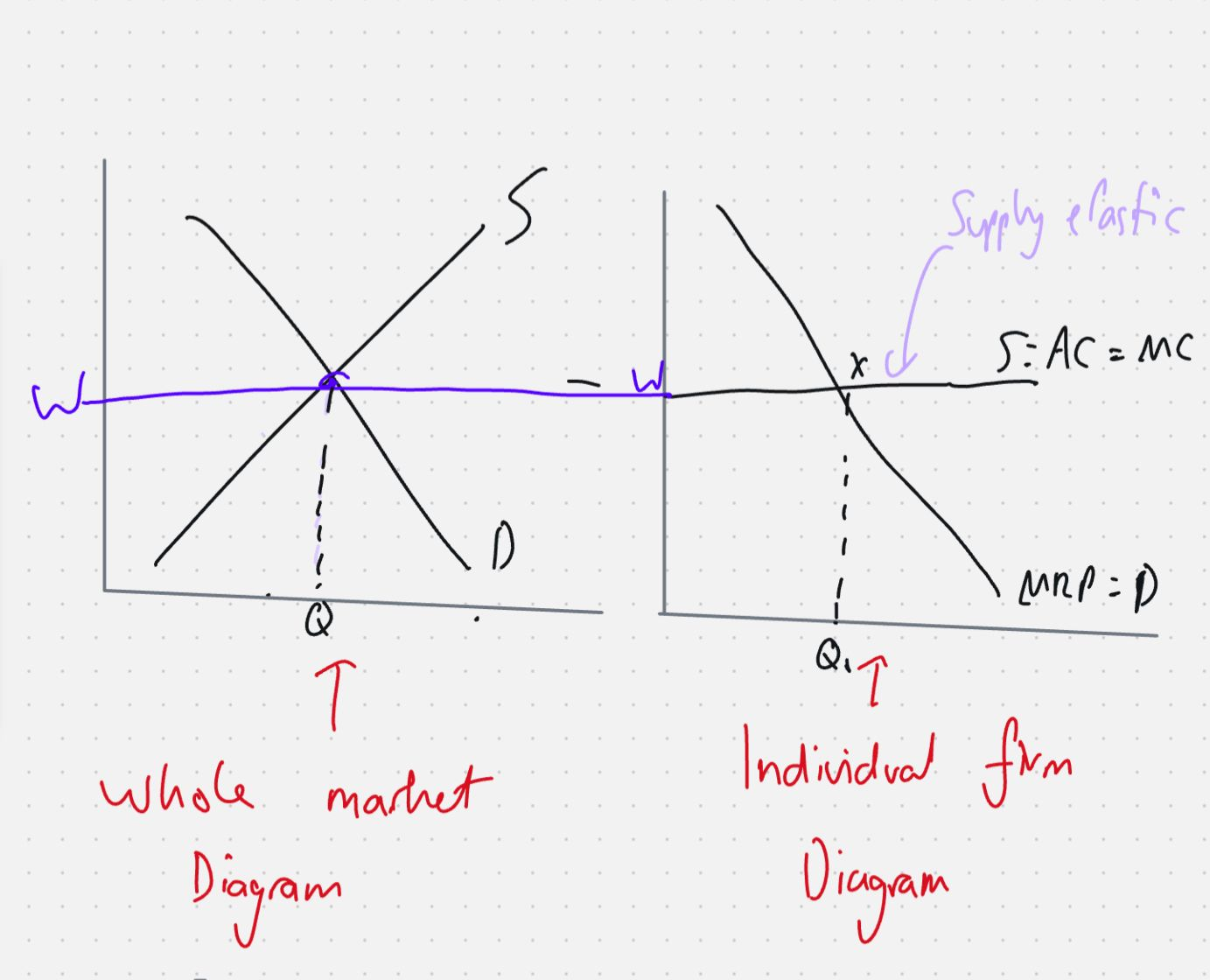
- Left diagram represents the entire labour market, governed by supply and demand forces, determining the wage rate (W*).
- Firms must accept this market wage rate.
- If firms pay below the equilibrium wage (W*), they lose workers.
- Firms pay W* and hire to maximize profits at the point where supply=demand.
Understanding of current labour market issues
1. Wage Inequality
- Differences in pay between occupations, genders, and regions.
- Causes: Differences in productivity, skills, education, experience, and discrimination.
- Policies: Minimum wage laws, equal pay legislation, education and training programmes.
- Example: The UK’s gender pay gap and regional pay differences
2. Skills Shortages
- Occurs when employers cannot find workers with the necessary skills.
- Causes: Rapid technological change, underinvestment in education, or mismatch between training and industry needs.
- Consequences: Limits economic growth, reduces productivity, and increases reliance on migration.
- Example: UK shortages in healthcare, engineering, and digital sectors.
3. Unemployment
- Types: Cyclical, structural, frictional, and seasonal.
- Current issues: Structural unemployment due to automation and post-pandemic shifts in demand.
- Policy responses: Retraining schemes, regional support, investment in infrastructure.
c) Government intervention in the labour market:
o Minimum wages

Pros of Increasing the Minimum Wage
- Reduces Poverty: Higher wages increase income and disposable spending power.
- Encourages Employment: If minimum wage exceeds welfare benefits, more people are incentivised to join the workforce.
- Prevents Exploitation: Ensures fair pay and protects workers from extremely low wages.
- Improves Productivity: Firms paying higher wages are more likely to invest in staff training, leading to greater efficiency, lower costs, and better-quality products.
- Increases Government Revenue: Higher earnings generate more income tax, which can be used to address labour market failures (e.g., improving housing and transport to reduce geographical immobility).
- Drives Efficiency: Rising labour costs encourage firms to become more productively efficient and innovative.
Cons
- Risk of Unemployment: Higher wage costs may force firms to lay off staff, lowering living standards and reducing tax revenue.
- Potential Inflation: Increased costs can lead to higher prices for consumers, reducing disposable income and living standards.
- Business Relocation or Closure: Some firms, especially smaller ones without economies of scale, may shut down or move abroad, reducing competition and job opportunities.
- Elasticity of Labour Demand: If labour demand is elastic, a wage rise could cause a significant drop in employment.
- Greater Labour Supply: Higher unemployment may increase flexibility for firms by expanding the available workforce.
- Government Support Matters: The impact depends on whether firms receive subsidies or other assistance to offset higher costs.
- Size of Wage Increase: Effects vary depending on how much the minimum wage is raised and what other costs firms face.
- Worker Moral Issues: Skilled employees may feel undervalued compared to less-skilled workers – >increasing staff turnover
o Maximum wages

Pros
- Reduce poverty ⇒ higher minimum wage ⇒ increased income ⇒ higher disposable income.
- Incentivises people to join the workforce → if the minimum wage is higher than benefits → unemployed people are encouraged to find a job.
- Reduces exploitation of staff → prevents firms from offering excessively low wages.
- Higher wages encourage productivity → firms paying more will invest in staff training → improved efficiency and productivity → lower costs → better quality products → benefits consumers.
- More income tax revenue for government → can be used to correct labour market failures (e.g. geographical immobility) by investing in housing and transport links ⇒ increases labour supply elasticity.
- Encourages firms to become more productively efficient as higher labour costs drive innovation and cost reduction.
Cons / Comments
- Can cause unemployment → higher minimum wage ⇒ increased firm costs ⇒ potential staff layoffs → lower living standards → less tax revenue for government.
- Higher costs ⇒ higher prices for consumers → reduces disposable income → worsens living standards and allocative efficiency.
- Some firms may close down or move abroad → fewer jobs, less competition, and reduced consumer choice → smaller firms struggle to cover costs (lack of economies of scale) → potential rise in monopoly power as larger firms survive --> exploit consumers.
- Depends on labour demand elasticity ⇒ if elastic, a higher wage leads to a large contraction in labour demand → greater unemployment and excess supply of labour.
- Higher unemployment can increase flexibility for firms → larger pool of available workers to choose from.
- Impact depends on government support → subsidies or other assistance could help firms manage higher costs.
- Effect varies with size of wage increase and other firm-specific cost factors --> if the wage cap is is small, will not have a significant impact.
- Possible moral issues → skilled workers may feel they deserve more than less-skilled colleagues → could lead to higher labour turnover among skilled staff --> reduce productivity for firm --> reduce productive efficiency and raise costs.
o public sector wage setting
- Definition: In the public sector (e.g., healthcare, education, government services), wages are set by the government rather than the market.
- Objective: The government are not profit maximisers so are likely to prioritise social welfare by paying a fair wage to workers and avoid labour market failures.
- In many areas, the government acts as a monopsonist, particularly in sectors like healthcare and education.
- The government has significant wage setting power, allowing them to pay less than the competitive market rate. However, since they are not profit maximisers and care more about society, this may not be a likely action they take.
o policies to tackle labour market immobility
- Invest in education → improve skills and human capital→ reduce occupational immobility
- Invest in healthcare → improve health and human capital → reduce occupational immobility
- Invest in housing → can easily relocate close to the desired job -->improve geographical mobility
- Improve infrastructure → better roads and transport systems --> improve geographical mobility
The mobility of labor is the ability of workers to move or change jobs.
Geographical immobility: This refers to the obstacles which prevent factors of production (labour) from moving between areas. For example, labour might find it hard to find work due to family and social ties, the financial costs involved with moving, imperfect market knowledge of work and the regional variations in house prices and living costs across the UK.
Occupational immobility: Workers may not have transferable skills to move from one job to another. For example if one industry declines, some workers will get laid off and will not be able to find a new job in the newly established sectors.