EDEXCEL A LEVEL ECONOMICS NOTES - 3.4 Market Structures
3.4 Market structures
3.4.1 Efficiency
PLEASE NOTE: The way I managed to do really well in Micro was my ability to link my analysis points to the efficiencies. My chains of analysis and thought process was all under the envelope of efficiencies. For example, if i wanted to think of analysis points for consumers i would think of my allocative efficiency points, if i wanted to think of profits or costs for firms, i would love link them to 'my' productive and dynamic efficiency points. I used this section as a home for my analysis points in micro. So this is why this section is very detailed as I want to know exactly how to talk about each economic agent in detail no matter what the question is. This approach provides a solid analytical framework
a) Allocative efficiency
Definition: Allocative efficiency occurs when resources are distributed in a way that maximizes consumer satisfaction. This is where P(AR):MC.
Causes of firms being more allocatively efficient
- Higher competition/tech/EOS/training → Lower costs → lead to lower prices
- Higher profits (dynamic efficiency) → improved quality & choice
Consumers impacted by:
- QUALITY
- CHOICE
- LOW PRICE
Analysis chain for essay: Consumer welfare improves → a firm is ‘more’ allocatively efficient.
Improve Quality → link to extract/example of how quality improved → explain how it increases consumer welfare → Hence increasing allocative efficiency. (See example paragraph below)
Bicycle monopolist Example (improved quality)
One benefit of a monopoly is that they are dynamically efficient. This is because they have price-making power and produce at the profit maximising point MC: MR (draw and link to diagram), where they earn supernormal profits shown by the shaded region. This is beneficial because the monopoly can use these profits in their bicycle company to improve the quality of bicycles. For example, they can invest in improving the seat's comfort and the tires' quality. Hence, the consumers will have an improved travel experience for commuting to work or to local areas. Therefore, as consumer welfare has improved, the firm will be more allocatively efficient and boost its brand loyalty in the long run.
Lower prices →
- reduce inequality/equity issues (fairness) → benefits low-income households → helps them afford necessities and potentially improve their standard of living → thus increasing allocative efficiency
How lower prices the Firm AND Consumer:
- Higher sales → Increase in revenue → increase in market share → Increase firm power in the long run → potentially become a monopoly if market share exceeds 25% → firm now has price-making power and can profit maximise by exploiting consumers with high prices → Consumers are worse off in the long run
- Lower prices → larger quantities sold → firm is scaling up → economies of scale benefits and higher choice for consumer
More choice/ variety in products →
More options meets more consumer preferences → increases consumer welfare → increasing allocative efficiency (use example using extract in exam to explain well)(Can combine with quality point in the essay)
Increasing allocative efficiency ultimately benefits the firm: Brand loyalty → Raise barriers to entry → Reduce contestability in the market
b) Productive efficiency
Definition: Productive efficiency is achieved when a firm produces at the lowest possible average cost (i.e., at the minimum point of the AC curve).
Analysis chain: Lower costs → increases productive efficiency
What leads to lower costs:
- Investing in new technology → Increases productivity and efficiency → Reduces waste and labour costs → Lowers overall production costs.
- Training workers → More skilled workforce → Higher productivity → Fewer mistakes and faster production → Lowers costs.
- Economies of scale → Larger production scale → Lower average costs in the long run due to bulk buying, specialization, and operational efficiency.
- Increase in competition → Firms are pressured to cut costs to stay competitive → Encourages innovation and cost-saving measures.
Analysis points
- Lower costs → lower prices → consumer welfare/market share (link to allocative efficiency points)
- Lower costs → higher profits → invest in Technology/Training/Growth (Dynamic efficiency points - see below)
Paragraph Example:
One benefit of an improvement in technology to a firm is that it makes them more productively efficient. This is because advanced technology may improve productivity within the firm hence lowering their costs and getting them closer to the lowest point of their AC curve. This is beneficial because lower costs can lead firms to cut their prices to boost their sales & brand loyalty which ultimately could increase their market share. Therefore, the firm can potentially become a monopoly if market share exceeds 25%, where they have significant economies of scale and price-making power to earn substantial profits. Hence, improved technology is very beneficial to a firm since it experiences significant growth in its sales and competitiveness.
c) Dynamic efficiency
Definition: Dynamic efficiency occurs when firms make supernormal profits and invest in innovation, technology, and research and development (R&D) to improve productivity and growth.
Effects
Better technology/Training workers → increase efficiency → lower costs (PE)→ can improve quality/choice/lower prices → Benefits consumers and boosts market share (AE points)
R&D and innovation → expand production and increase choice → meets more consumer preferences → consumer welfare improves and hence allocative efficiency → improve brand loyalty for the firm → raising entry barriers.
Invest in buildings/growth of business → Economies of scale benefits
d) X-inefficiency
Definition: X-inefficiency occurs when firms operate at higher costs than necessary due to a lack of competitive pressure, usually seen in monopolies.
3.4.2 Perfect competition
a) Characteristics of perfect competition
This is a type of market structure where this model assumes that all firms have no price-making power and that they all produce identical products.
Characteristics:
- Price takers→ Must accept the market price as they have no influence over it.
- Homogeneous products → All firms produce identical goods, meaning no brand differentiation.
- No barriers to entry/exit → Firms can freely enter or leave the market based on profitability.
- Profit maximisers → Firms aim to produce at the output level where MC = MR to maximise profits.
Short run equilibrium in perfectly competitive market:
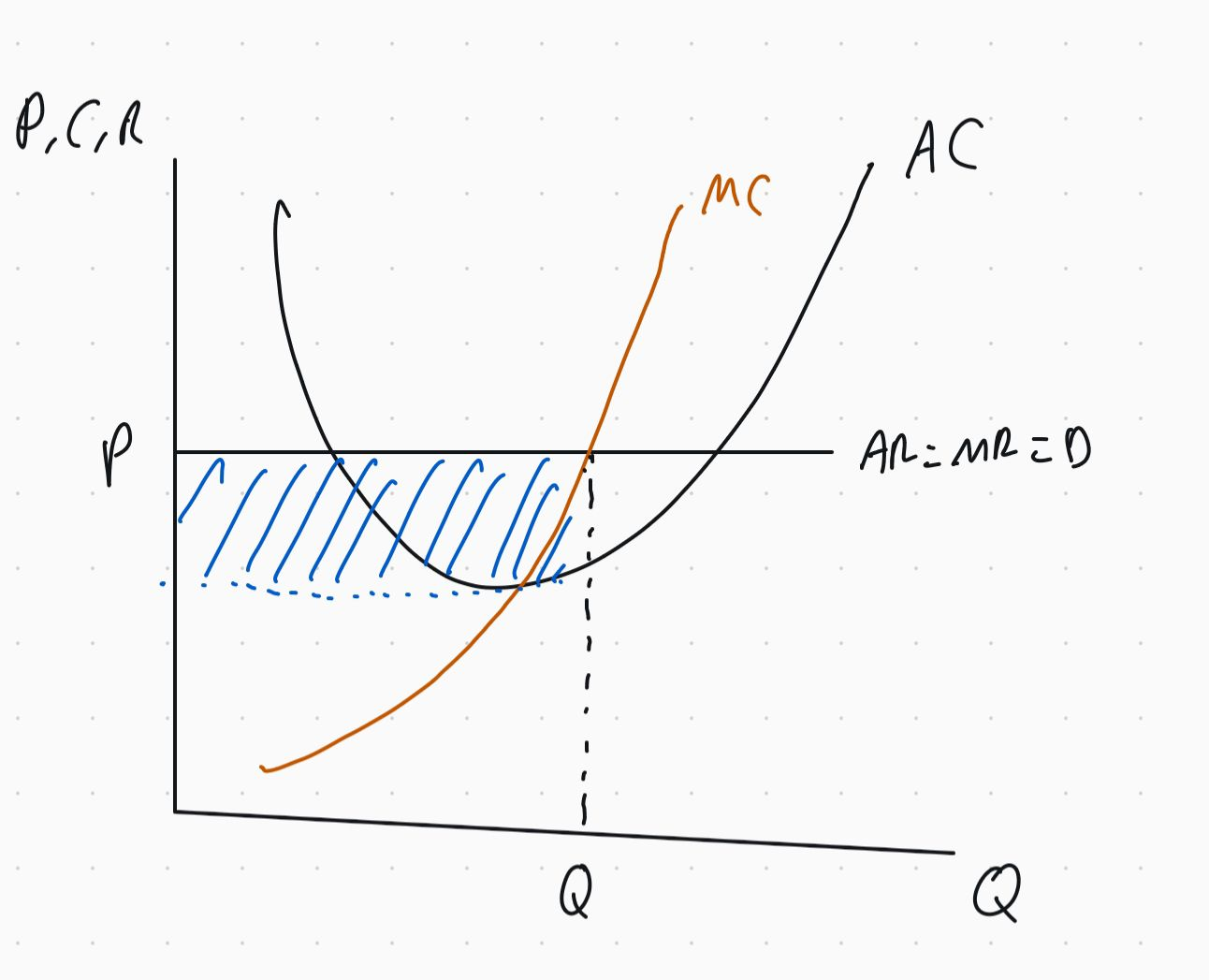
In perfect competition, the demand curve for an individual firm is perfectly elastic, shown by a horizontal AR (Average Revenue) curve.
- This happens because the firm is a price taker, meaning it has no control over the market price.
- All firms produce homogeneous products, so there is no differentiation.
- If a firm raises its price, consumers will switch to competitors offering the same product at the market price, causing the firm to lose all its customers.
- In the short run, the firms' AR is greater than AC, so they are making some supernormal profits as seen by the shaded region.
Allocatively efficient: Yes (AR does equal MC)
Dynamically efficient: slightly in the SR
Productively efficient: No (Not at lowest point of AC)
Long run equilibrium in perfectly competitive market:
In the long run, the firm will continue to produce at the point where MC = MR (Profit Maximizing Output).

- In the short run, supernormal profits attract new firms into the market due to the lack of barriers to entry.
- These new firms will steal share the sales with their rivals resulting in all firms reaching a point where they only make normal profits (break-even point), as their AR (Average Revenue) curve shifts downward.
Productively efficient: Yes at lowest point of AC
Allocatively efficient: Yes as MC: AR
Dynamically efficient: No as only normal profits.
3.4.3 Monopolistic competition
a) Characteristics of monopolistically competitive markets
b) Profit maximising equilibrium in the short run and long run
c) Diagrammatic analysis
3.4.4 Oligopoly
a) Characteristics of oligopoly
o high barriers to entry and exit
o high concentration ratio
o interdependence of firms
o product differentiation
b) Calculation of n-firm concentration ratios and their significance
c) Reasons for collusive and non-collusive behaviour
d) Overt and tacit collusion; cartels and price leadership
e) Simple game theory: the prisoner's dilemma in a simple two firm/two outcome model
f) Types of price competition:
o price wars
o predatory pricing
o limit pricing
g) Types of non-price competition
3.4.5 Monopoly
a) Characteristics of monopoly
- High barriers entry
- Price makers (market power)
- Supernormal profits (dynamically efficient)
- Market share>25%
- Economies of scale
- Allocatively inefficient
- Productively inefficient
Diagrammatic analysis
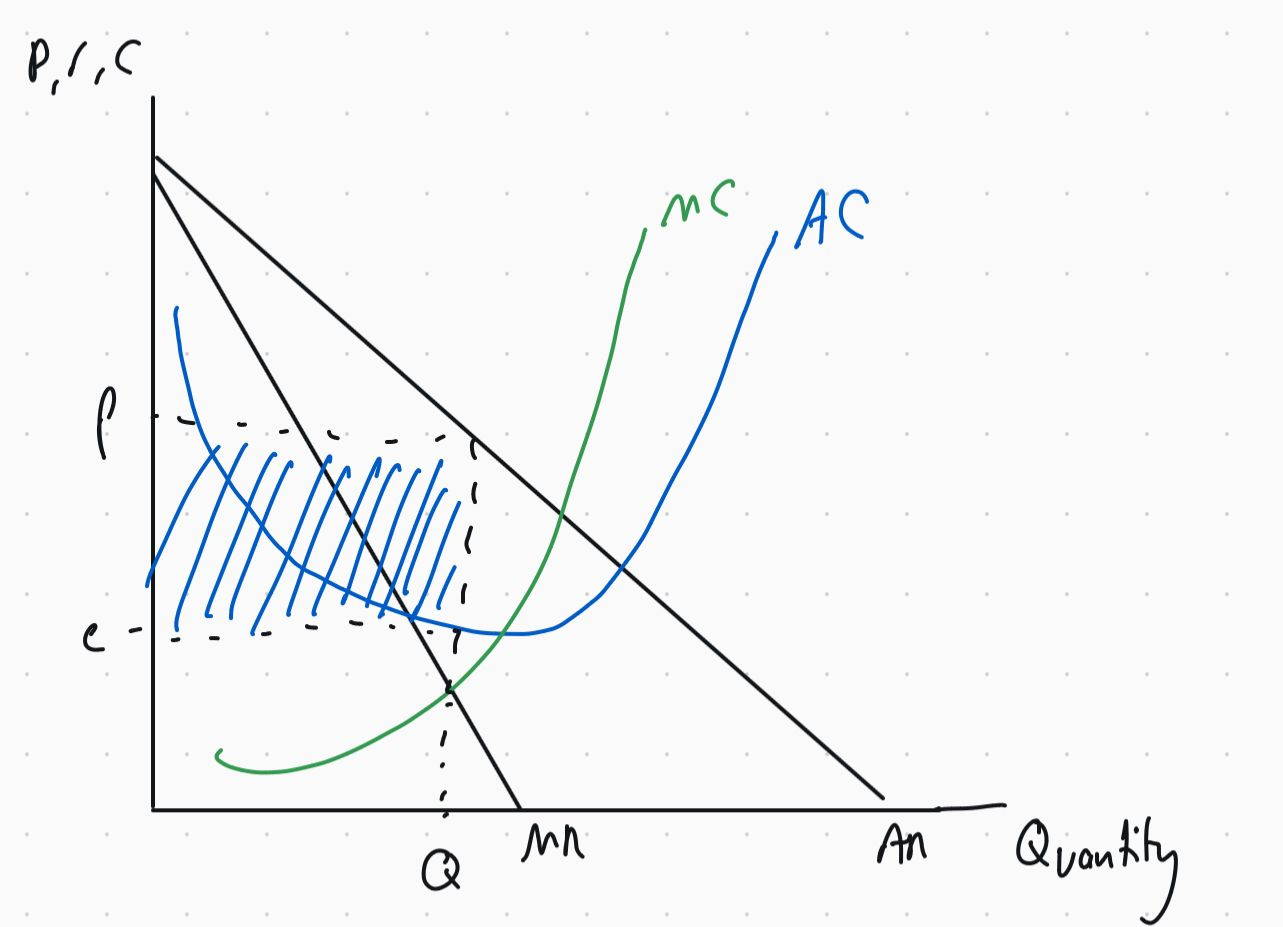
- AR curve slopes downward due to monopoly's price-making power.
- Monopoly restricts output, maximizing profit at MC=MR (point Q1).
- At Q1, AR>AC, earning supernormal profits, and considered dynamically efficient.
- Consumers are worse off due to high prices and restricted output, leading to allocative inefficiency (not producing at MC=AR).
- High barriers to entry and lack of competition result in monopolies being X-inefficient, as they're not motivated to minimize waste.
- Monopolies may not operate at lowest point of AC curve due to lack of competition and barriers to entry, minimizing cost efficiency.
Benefits of Monopolies
- Consumers
- Innovation & Better Quality: Monopolies earning supernormal profits can invest more in R&D, leading to more innovative products and better quality. This boosts consumer choice as new and improved goods become available. For example, companies like Apple, which operate with some monopolistic characteristics, innovate constantly to maintain their market position. This improves allocative efficiency as consumers benefit from a wider range of high-quality products.
- Economies of Scale (EOS): Monopolies benefit from EOS, which can lower production costs in the long run. These cost savings can be passed on to consumers through lower prices, benefiting low-income households by enabling them to retain more of their income and improve their living standards. EOS also makes firms more productively efficient, allowing for reinvestment into further product improvements for consumers. This can be linked to the Natural Monopoly concept, as they have consistent EOS and no Diseconomies of Scale (DOS).
- Workers
- Job Security: With no competition, monopolies are not pressured to cut costs, like labour costs, and can afford to maintain good working conditions and better job security.
- Higher Pay: Supernormal profits allow monopolies to offer higher salaries, improving the standard of living for workers.
- Government
- Higher Tax Revenue: Due to their high supernormal profits, monopolies contribute significantly to corporation tax. Additionally, monopolies, especially global companies, can generate export revenues, further boosting the national economy.
- Lower Unemployment: High profit margins enable monopolies to hire more staff, reducing unemployment in the economy.
Negatives of Monopolies
- Consumers
- Reduced Choice & Quality: Despite being dynamically efficient, monopolies may not innovate as much in the absence of competition. This leads to less product variety, reducing allocative efficiency and consumer welfare.
- Higher Prices: Monopolies tend to set high prices due to restricted output. This harms low-income households and increases equity issues, worsening their standard of living and reducing allocative efficiency. (You can illustrate this with a Monopoly diagram, showing profit maximization at a high price and restricted output.)
- Predatory Pricing: To eliminate competitors, monopolies may temporarily lower prices below break-even to drive firms out of the market. This harms other firms and leads to reduced competition in the long run, which ultimately raises prices and restricts consumer choice.
- Limit Pricing: Monopolies may lower prices to below break-even to make it impossible for new firms to enter the market and compete. This raises barriers to entry, reducing market contestability and leading to fewer choices for consumers, while increasing the monopoly's power. (In the short run, limit pricing can benefit consumers through lower prices, but in the long run, it reduces competition.)
Evaluative Points/Comments
- Level of Contestability: The degree of market contestability influences monopoly behaviour. If the market is contestable, monopolies may avoid profit maximization and high prices to deter new entrants. This can benefit consumers by lowering prices, increasing output, and improving product quality to maintain brand loyalty.
- Level of Regulation: Strong regulations can limit monopolies' ability to raise prices and profit maximize. To avoid scrutiny, they may lower prices and increase output, which benefits consumers.
- Motives of the Monopoly: In reality, monopolies may not always be profit maximisers. They could be focused on corporate social responsibility (CSR) or aiming to maximize revenue rather than pure profit.
- Type of Monopoly: The type of monopoly matters. A natural monopoly with 100% market share has even more power to exploit consumers, as they control the entire market, offering fewer choices at higher prices.
- Price Discrimination: Monopolies may engage in price discrimination, charging different prices based on factors like age, location, time, or income. This can lead to some consumers being better off (e.g., discounts for students) and others worse off (e.g., higher prices for those who don’t qualify for discounts). A good example is TFL (Transport for London), which uses price discrimination based on time and age.
Example of how I would structure some of these evaluations in an essay:
Limit price disadvantage:
One cost of a monopoly is that they may limit price due to their price-making power. This is when they charge a price below BE, to prevent new firms from entering the market and being profitable. Although the consumer will be better off in the short run due to the lower prices, in the long run the consumer may be worse off. This is because less firms will be entering the market to compete with the monopoly as its less contestable, resulting in less competitors and thus less choice for the consumer. Furthermore, the monopoly will still have significant power and will exploit consumers in the form of higher prices and potentially poor quality products due to the lack of rivals. Hence, limit pricing can harm allocative efficiency and make consumers worse off.
Business objectives evaluation:
However, whether a consumer's welfare is harmed may depend on the objectives of the firm. This is because not all monopolies may be profit maximisers, and instead may have more consumer friendly objectives such as growth maximisation. This will result in the firm potentially lowering prices to scale up further and expanding production. This is beneficial because ….
Natural Monopoly
- 100% Market Share: A natural monopoly controls the entire market, making it the sole provider.
- High Fixed Costs: Natural monopolies, like TFL, face very high fixed costs—building infrastructure, purchasing expensive technology, and hiring workers. This creates a significant barrier for new firms to enter the market.
- Consistent Economies of Scale (EOS): As natural monopolies increase output, fixed costs are spread over a larger range, leading to consistently lower costs in the long run. This is especially true since they have low marginal costs.
In the diagram, the LRAC curve falls continuously because of consistent EOS as output increases. The monopoly sets its price at the point where MC = MR (at P1 and Q1), leading to supernormal profits (yellow region), indicating dynamic efficiency.
- Allocative Efficiency: If the monopoly were allocatively efficient, its price would be at the point where MC = AR (P2). However, at this lower price, the AC is greater than AR, leading to a loss (green shaded region).
d) Third degree price discrimination:
- Definition: Third-degree price discrimination occurs when a firm charges different prices to different consumers based on factors like time, location, age, or income.
o necessary conditions
- Price-Making Power: The firm must have the ability to set its own prices (e.g., monopoly or monopolistic competition).
- Two Distinct Markets: The firm must be able to segment the market into two or more distinct groups of consumers.
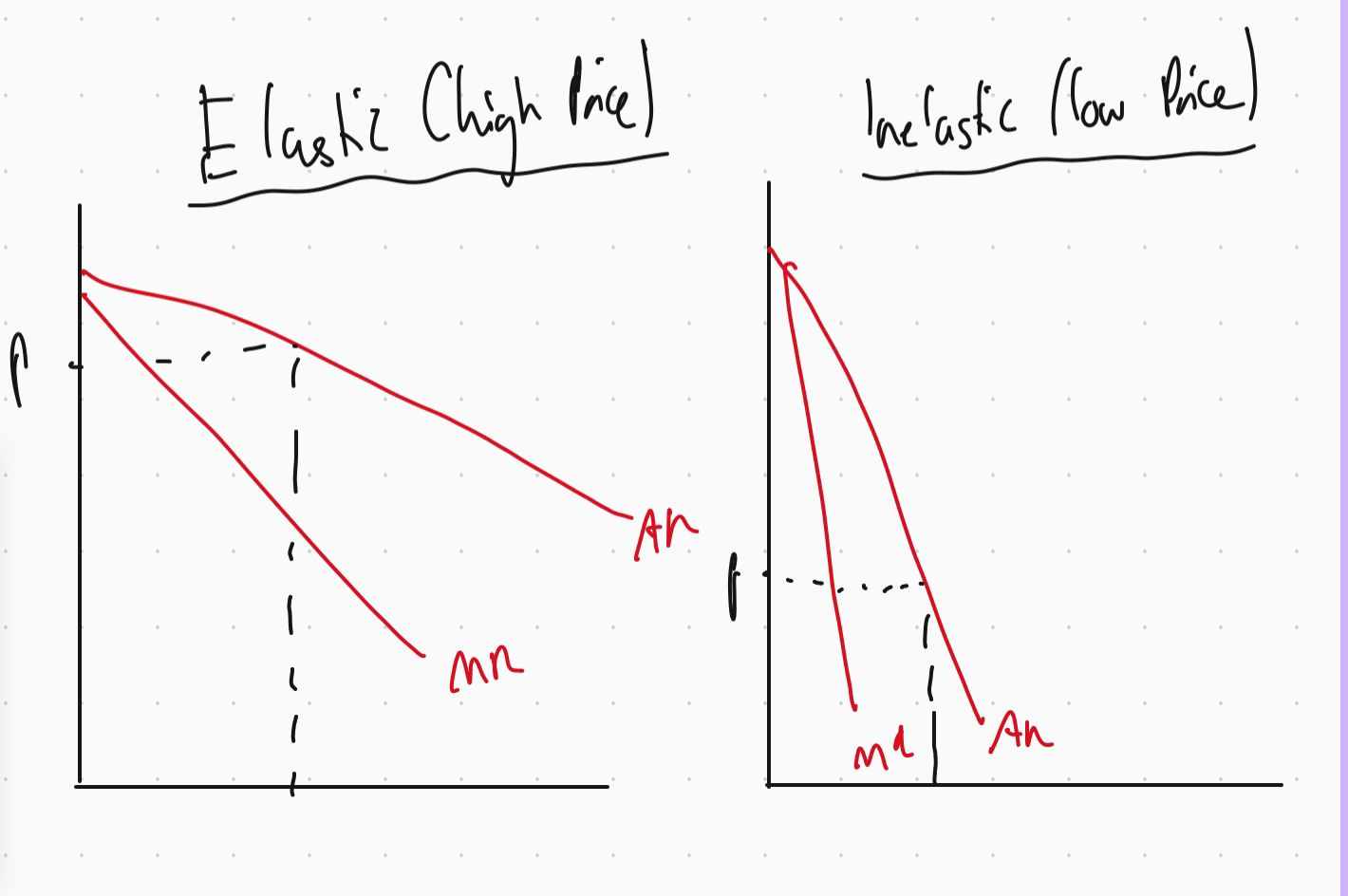
- Different Price Elasticities of Demand (PEDs): The firm must be able to identify groups with different sensitivities to price changes (e.g., peak train tickets are elastic, whereas non-peak are inelastic).
- No Undercutting by Suppliers: The firm must prevent arbitrage, where consumers from one market resell the product to those in another market at a lower price.
Advantages
- Abnormal Profit: Price discrimination allows firms to earn supernormal profits, which they can reinvest into R&D, improving product quality, expanding consumer choice, and building brand loyalty. This leads to increased sales, market share, and economies of scale (EOS).
- Benefit for Low-Income Households: Consumers like pensioners or low-income households may pay lower prices, increasing their consumer surplus and improving their standard of living. This helps them afford necessary goods and services, easing issues of equity and allowing better access to jobs.
- Efficient Use of Resources: Charging higher prices during peak times (e.g., rush hour) reduces overcrowding and makes better use of available capacity, ensuring that people who need to travel during these times can do so.
- Cross-Subsidization: Profits from high-demand periods can subsidize loss-making routes during non-peak times. This ensures more choice and better geographical mobility for consumers, making it easier to find work and earn an income.
Disadvantages
- Unfairness to Some Consumers: Consumers who are charged high prices, especially those who cannot afford them, may be at a disadvantage. This could leave low-income individuals or the jobless unable to access necessary services, exacerbating issues of fairness and equity.
- Complexity in Implementation: Price discrimination can be difficult and expensive for firms that sell a variety of products. For firms focused on profit maximization, this added complexity may reduce productive efficiency, leading to higher costs and potentially lower profits.