EDEXCEL A LEVEL ECONOMICS NOTES - 1.3 Market Failure
1.3.1 Types of Market Failure
a) Understanding Market Failure
Market failure occurs when the free market fails to allocate resources efficiently, leading to a loss of economic and social welfare.
b) Types of Market Failure
- Externalities – Costs or benefits affecting third parties not involved in the transaction.
- Under-provision of public goods – Goods that are non-rivalrous and non-excludable are often under-supplied by private firms.
- Information gaps – Imperfect or asymmetric information that prevents consumers or producers from making fully informed decisions.
1.3.2 Externalities
a) Costs
- Private costs – Costs borne directly by the producer.
- External costs – Costs imposed on third parties not involved in the production or consumption.
- Social costs – Total costs to society: private costs + external costs.
b) Benefits
- Private benefits – Benefits received by the consumer or producer directly involved.
- External benefits – Benefits received by third parties.
- Social benefits – Total benefits to society: private benefits + external benefits.
c) External costs of production
- Illustrated using a marginal analysis diagram:
- Supply = marginal private cost (MPC)
- Social optimum = marginal social cost (MSC)
- Market equilibrium = where demand intersects MPC
- Welfare loss area = triangle between MSC and MPC above equilibrium quantity
d) External benefits of consumption
- Illustrated using marginal analysis:
- Demand = marginal private benefit (MPB)
- Social optimum = marginal social benefit (MSB)
- Market equilibrium = where supply intersects MPB
- Welfare gain area = triangle between MSB and MPB above equilibrium quantity
(healthy drinks)
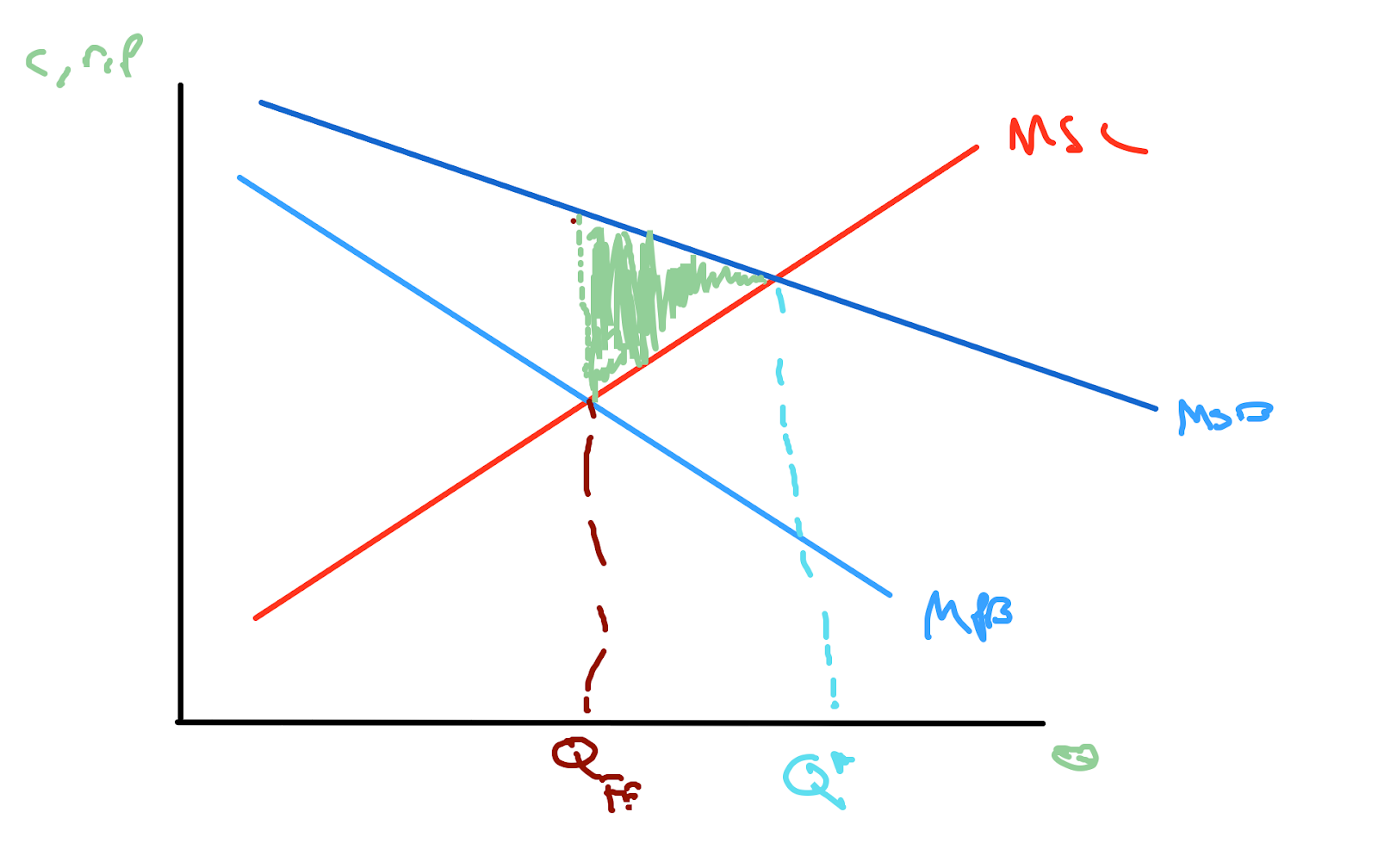
At the free market equilibrium shown at Qfm, there is a misallocation of resources and market failure. This is because there is an underconsumption of healthy drinks and a welfare loss to society shown by the shaded region. For example, healthy drinks bring positive externalities to society such as improving a consumers health and improving the families happiness at home. To get to the socially optimal level, the government may need to intervene with a subsidy to encourage firms to produce more and cut prices to increase consumption. Thus output will be at Q* which is the socially optimal level as MSB:MSC and hence market failure is corrected.
e) Impacts and Government Intervention
- Economic agents affected: consumers, producers, and third parties
- Government intervention: taxes, subsidies, regulation, or legislation to correct externalities
1.3.3 Public Goods
a) Public vs Private Goods
- Public goods – Non-rivalrous (one person’s consumption doesn’t reduce another’s) and non-excludable (cannot prevent people from using it).
- Private goods – Rivalrous and excludable.
b) Free Rider Problem
- Private sector may under-provide public goods because people can benefit without paying, reducing incentives for firms to supply them.
1.3.4 Information Gaps
a) Symmetric vs Asymmetric Information
- Symmetric information – All parties have equal information.
- Asymmetric information – One party has more or better information than the other.
b) Consequences
- Imperfect market information can lead to misallocation of resources, e.g., overconsumption of low-quality goods or underproduction of high-quality goods.
1.4.1 Government Intervention in Markets
a) Purpose of intervention
The government intervenes in markets to correct market failures and improve economic and social welfare. Diagrams can illustrate how these interventions affect prices, quantities, and welfare.
Types of intervention:
- Indirect taxation
- Specific tax – A fixed amount per unit (e.g., £1 per packet of cigarettes).
- Ad valorem tax – A percentage of the price (e.g., 20% VAT).
Advantages
Raises price of the good → reduces consumption → internalises the negative externality by removing deadweight loss (DWL) → corrects market failure → output moves to the socially optimal level (shown using an externality or S&D diagram).
Incentivises firms to invest in cleaner and more efficient technology → lower emissions → reduced pollution → improves allocative efficiency.
Generates tax revenue → government can fund education campaigns (e.g. raising awareness of the health risks of smoking) → promote merit goods such as healthy drinks → increase positive externalities → higher overall welfare for society.
Disadvantages / evaluation
Depends on the level of information available to the government → difficult to measure the true size of the external cost → hard to calculate the exact tax needed to remove DWL → risk of under-taxing → continued overconsumption above the socially optimal level → market failure remains → potential government failure.
Depends on how firms respond to the tax → firms with significant economies of scale (EOS) and low costs may absorb the tax → prices do not rise significantly → consumption does not fall → negative externalities persist → DWL remains.
Regressive impact → higher prices affect all consumers → low-income households are worse off → increased inequality → reduced living standards.
Effectiveness depends on PED → goods like cigarettes are addictive and price inelastic → tax leads to only a small fall in consumption → overconsumption continues → negative externalities remain → government failure in correcting market failure.
Black markets may emerge → illegal and unrecorded markets → continued sale of the demerit good → ongoing negative externalities → government also loses potential tax revenue.
Higher costs for firms → firms with high costs and limited EOS may exit the market → reduced competition → increased market power → risk of monopoly → further market failure.
- Subsidies
- Payment to producers to reduce costs or encourage production.
Incentive for producers to supply more → increases supply → lowers prices → increases consumption of goods with positive externalities (e.g. subsidising healthy food and drinks) → output increases to the socially optimal level (shown by a rightward shift of the supply curve) → corrects market failure by reducing underproduction.
However, it is difficult to determine the correct size of the subsidy → hard to measure the true social benefits → subsidy may be too small due to government information failure → underproduction remains → deadweight loss (DWL) persists → market failure → government failure.
Firms can use subsidies to invest in other areas of the business → improve efficiency and quality → invest in greener technology → reduce pollution → fewer negative externalities.
However, firms may become inefficient and dependent on government support → subsidies may be used to increase shareholder dividends rather than expand output or reduce prices → waste of government funds → opportunity cost for the government → taxpayers ultimately bear the burden.
Effectiveness depends on PED → even with lower prices, demand may not increase significantly if demand is price inelastic → continued underconsumption → DWL remains → market failure persists.
- Maximum and minimum prices
- Maximum price – Price ceiling to make goods more affordable (e.g., rent controls).
Maximum price – Rent controls
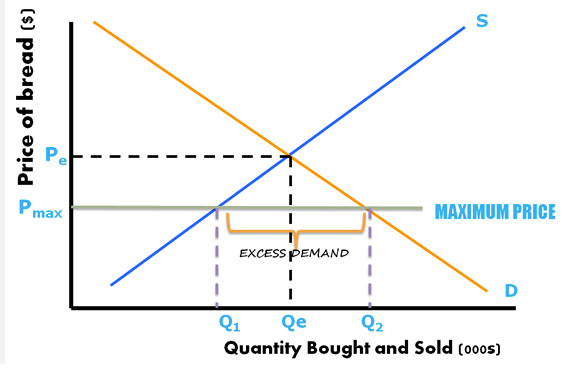
The diagram shows the market for rented accommodation. If the government believes rent is too high, it can intervene by setting a maximum price (Pmax) below the free market equilibrium.
At Pmax, rent is lower and therefore less profitable for landlords → landlords contract supply, while lower prices increase demand for housing → this creates excess demand between Q2 and Q1, leading to a shortage in the market.
Advantages
Promotes equity → makes housing more affordable for low-income households → reduces inequality and improves living standards.
Prevents exploitation → landlords cannot charge excessively high rents → protects vulnerable tenants.
May reduce homelessness → lower rents increase access to housing → improves social welfare.
Encourages efficiency → landlords earn lower profits → pressure to cut costs and operate more efficiently.
For merit goods like housing → lower prices increase consumption → higher positive externalities (e.g. better health and social stability).
Disadvantages
Creates disequilibrium → price is set below equilibrium → excess demand → allocative inefficiency and market distortion.
Black markets may develop → illegal side payments or “key money” → tenants may pay above the legal rent → government loses control and potential revenue.
Lower profitability for landlords → cut back on maintenance and repairs → housing quality deteriorates → reduced consumer welfare.
Disincentivises new firms from entering the market → lower expected profits → reduced competition → long-run inefficiency.
Effectiveness depends on how low the price cap is → if set too low, landlords may make losses → exit the market → further reduction in supply → worsens shortages.
Depends on the government’s level of information → difficult to set the correct maximum price → risk of government failure.
Depends on PED → if demand for housing is price inelastic, shortages will be large and persistent.
If you want, I can:
- Add exam-ready evaluation lines
- Link this directly to 25-mark essays
- Pair this with a perfect diagram explanation paragraph
- Minimum price – Price floor to protect producers (e.g., minimum wage, agricultural support).
- Minimum price
Why?
To protect producers’ incomes (e.g. farmers) or to reduce consumption of demerit goods such as alcohol by setting a price floor above the free market equilibrium.
Advantages
Higher price for firms → higher revenue and profitability → firms can invest more → improve quality and productivity.
Incentivises firms to remain in or enter the market → stronger supply → more competition, choice, and potentially better quality → improved consumer welfare in the long run.
Helps protect firms from price volatility → more stable incomes → encourages long-term planning and investment.
Disadvantages
Higher prices reduce consumer surplus → consumers pay more → equity issues, especially for low-income households.
Effectiveness depends on elasticity of supply → if supply is inelastic, excess supply will be large and persistent.
Creates excess supply → surplus output → market inefficiency and waste.
Black markets may develop → illegal sales below the minimum price → undermines policy and reduces government control.
Protects inefficient producers → firms have less incentive to cut costs or innovate → productive inefficiency.
Distorts market forces of supply and demand → price no longer reflects scarcity or consumer preferences.
Effectiveness depends on how high the minimum price is set → if set too high → large surpluses → misallocation of resources → market failure → potential government failure.
b) Other methods of government intervention:
- Tradeable pollution permits – Limit total pollution and allow firms to buy/sell permits.
Advantages
Pollution permits incentivise firms to reduce emissions → firms that invest in cleaner, greener technology can cut pollution → sell unused permits → receive revenue → reinvest into the business.
Overall pollution levels fall → negative externalities are reduced → deadweight loss (DWL) to society falls → output moves towards the socially optimal level → market failure is corrected.
Government can raise revenue from selling permits or fines → funds can be invested in merit or public goods → increase social welfare.
Evaluations/Disadvantages
Difficult for the government to determine the correct number of permits → hard to quantify the true social cost of pollution → risk of issuing too many permits → over-pollution → large negative externalities and DWL → government failure.
Firms may use profits from selling permits for private benefit rather than investing in clean technology → limits the effectiveness of the policy.
Ethical concerns → large firms with high profits can afford to buy many permits → continue polluting more than smaller firms → inequitable outcomes.
If enforcement relies mainly on fines → large firms may not be significantly affected → continue polluting. However, reputational damage may still discourage excessive pollution, as long-run brand image and sales could be harmed.
- State provision of public goods – Ensures provision of goods that would not be supplied by the private sector.
- State provision
State provision is when the government directly provides goods and services, such as education, healthcare, or public transport.
Advantages
Similar to a command economy approach → government controls production and allocation → ensures essential goods are provided based on need rather than ability to pay.
Corrects the free-rider problem → goods like street lighting or defence would be underprovided by the private sector → state provision ensures universal access.
Can improve equity → reduces inequality → ensures access to merit goods → increases positive externalities and overall welfare.
Counter-arguments / disadvantages
Private sector may be more efficient → stronger profit incentives → greater cost control and innovation → higher productive efficiency.
Lack of competition in state provision → risk of X-inefficiency → higher costs and lower quality.
Government failure → insufficient information about consumer preferences → misallocation of resources → over or under-provision of goods and services.
- Provision of information – Reduces information gaps and helps consumers make better choices.
Advantages
- Information provided alter consumer behaviour → correct market failure
- Tackle information gap → make more informed decisions
- Cheap (labels)
- Effective due to pictures and health warnings
- Implement into education → long term benefits
Disadvantages
- Not compulsory → dont work → misallocation of resources still → government failure
- Government may lack information
- Unreliable
- Illiterate
- Firms disguise information
- Regulation – Rules to limit harmful behaviour or enforce standards (e.g., safety, environmental laws).
Advantages
- Easy to understand → controls economic activity and sets a clear standard something is wrong
- Backed by the law and fines→ incentive for firms to comply
- Fairer than taxes as high income earners may be ok with paying higher VAT than low income HH
- Reduce negative externalities → socially optimal level (draw externality diagram)
Disadvantages
- Lead to people breaking the law
- Expensive to monitor firms so opportunity cost → use to invest in education → boost + externalities
- Fines may not work if the firm has low costs and significant EOS → government failure
- Black market → illegal markets
- Need for international agreement → complicated
- Reduce competition → regulations may deter new firms from entering and raises barriers to entry → reduce efficiency and lead to higher prices
- What standard should be set? What Fine is fair?
- Difficult to make firms obey the laws
- Difficult to monitor all activities and enforce the law
- Some firms may be able to stand firm in legal disagreements as they are powerful and well resources.
1.4.2 Government Failure
a) Understanding government failure
Government failure occurs when government intervention leads to a net welfare loss rather than improving efficiency.
b) Causes of government failure:
- Distortion of price signals – Interventions like subsidies or price controls can prevent the market from signalling scarcity or abundance.
- Unintended consequences – Policies may create behaviour that worsens the problem (e.g., minimum wage causing unemployment in some sectors).
- Excessive administrative costs – High costs of monitoring, enforcement, or implementation may outweigh the benefits.
- Information gaps – Government may not have perfect knowledge, leading to inefficient decisions.
c) Examples of government failure in various markets:
- Agricultural markets – overproduction due to subsidies.
- Housing – rent controls creating shortages or poor quality housing.
- Labour markets – unintended unemployment from wage floors.