EDEXCEL A LEVEL ECONOMICS NOTES - 1.1 Nature of Economics
1.1.1 Economics as a social science
a) Thinking like an economist: the process of developing models in economics, including the need to make assumptions
b) The use of the ceteris paribus assumption in building models
Ceteris Paribus: When we assume only one variable changes and all others are held constant.
For example: Ceteris paribus, if a student studies more hours, their test score will improve - assuming everything else stays the same (same teacher, same health, same sleep).
c) The inability in economics to make scientific experiments
In economics, it is difficult to carry out scientific experiments in the same way as in subjects like chemistry or physics. This is because economists study human behaviour, which is complex and constantly changing. People do not always act in predictable or rational ways, making controlled experiments hard to design.
1.1.2 Positive and normative economic statements
a) Distinction between positive and normative economic statements
Positive statement: A statement that deals with facts. For example, the government increased spending by 1% in November.
Normative statement: Deals with value judgements. For example, Tom should go to school tomorrow as it is good for him. ‘Should’, ‘ought’
b) The role of value judgements in influencing economic decision making and policy
Value judgements influence economic decisions because governments must decide what they believe is fair or best for society. For example, choosing to raise taxes or increase welfare spending depends on beliefs about equality and fairness, not just economic data.
This means economic policy is shaped by both facts (positive statements) and opinions (normative statements).
1.1.3 The economic problem
a) The problem of scarcity – where there are unlimited wants and finite resources
Economic problem: Is that resources are finite, but human wants are unlimited. The problem of scarcity.
Scarcity: Where there are not enough resources to meet our unlimited wants and needs.
Opportunity cost: The next best alternative is forgone.
Since resources are finite, people, firms and the government must make choices about how to use their resources. Whenever a choice is made, the next best alternative is forgone (given up). This is called opportunity cost.
For example, if you study economics instead of watching a movie, the opportunity cost is the enjoyment of the movie.
For example, if a firm uses land to build a factory, the opportunity cost is the houses that could have been built on the land.
b) The distinction between renewable and non-renewable resources
Renewable resources:Natural resources that can be replaced or replenished naturally over time, so they do not run out if used sustainably.
Non-renewable resources:Natural resources that are in finite supply and cannot be replaced once used up within a human timescale.
c) The importance of opportunity costs to economic agents (consumers, producers and government)
1.1.4 Production possibility frontiers
a) The use of production possibility frontiers to depict:
o the maximum productive potential of an economy
PPF: Is a curve that shows the maximum possible combinations of two goods or services that an economy can produce with its available resources and technology, assuming all resources are fully employed.
In simple terms: It shows the trade offs an economy faces when deciding how to use scarce resources.
Points inside the PPF indicate underutilisation of resources, such as unemployment or inefficiency, while points outside the PPF are unattainable with current resources and technology.
Therefore, the PPF illustrates the maximum productive potential of an economy at a given point in time.
o opportunity cost (through marginal analysis)
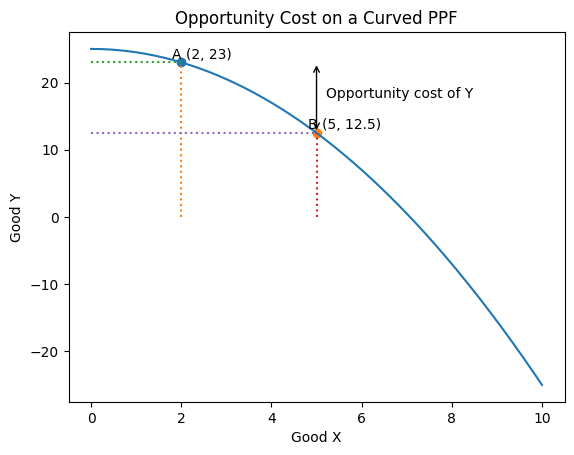
Point A (2, 23) and point B (5, 12.5) are both on the PPF, meaning resources are used efficiently.
Moving from A to B increases the production of Good X from 2 to 5 units. The opportunity cost is the loss of Good Y, which falls from 23 to 12.5 units.
This loss of Good Y is shown by the vertical distance between A and B.
Because the PPF is curved, opportunity cost increases as more of Good X is produced. This is known as increasing marginal opportunity cost.
o economic growth or decline

Economic growth refers to a long-term increase in productive capacity. As the economy grows, it can produce more of all goods and services, which is shown by an outward shift of the PPF. Economic growth is often the result of investment, improved education, and technological progress.
The opposite is the case for when there is an economic decline. There will be a decrease in the productive capacity, and hence a leftward shift in the PPF.
Increase in the quantity or quality of labour
An increase in the number of workers (e.g. population growth or immigration) or an improvement in labour quality (through education and training) raises labour productivity. This enables the economy to produce more, shifting the PPF outwards.
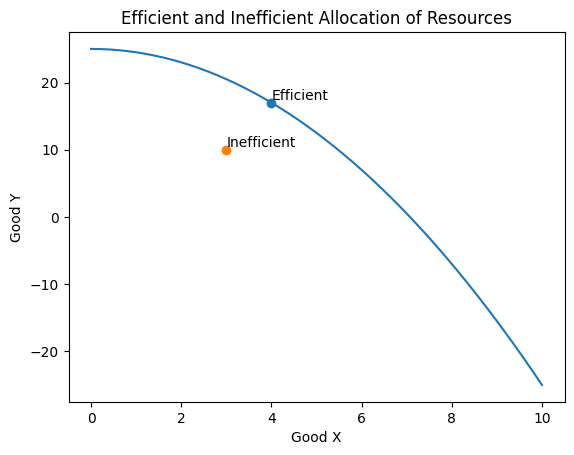
o efficient or inefficient allocation of resources
Efficient: Any point on the PPF as the economy is utilising all of their resources ie no resources are being wasted.
Inefficient: Within the PPF. The economy is not utilising all of their resources.
o possible and unobtainable production
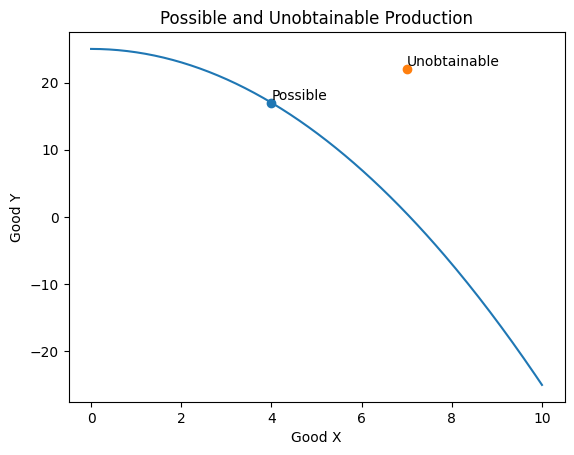
- Possible production: Any point on or inside the PPF, achievable with current resources.
- Unobtainable production: Any point outside the PPF, which cannot be reached unless there is economic growth.
b) The distinction between movements along and shifts in production possibility curves, considering the possible causes for such changes
- Movement along the curve: Producing more of one good means producing less of the other. This trade-off illustrates opportunity cost — the amount of one good that must be given up to produce more of the other.
Shift in the PPF
Increase in the quantity or quality of resources (factors of production)
If an economy has more or better-quality factors of production, such as labour, capital, or land, it can produce more output. For example, an increase in skilled labour or investment in new machinery improves productive capacity. This causes the PPF to shift outwards.
Economic growth
Economic growth refers to an increase in an economy’s productive potential over time. As the economy grows, it becomes capable of producing more goods and services than before, leading to an outward shift of the PPF.
Advancement in technology
Technological improvements allow firms to produce more output using the same amount of resources. For example, automation or improved production methods increase efficiency, which shifts the PPF outwards.
Increase in the quantity or quality of labour
An increase in the size of the workforce or improvements in education and training raise labour productivity. This enables higher levels of output, resulting in an outward shift of the PPF.
c) The distinction between capital and consumer goods
Consumer goods:Goods that are produced for direct consumption by consumers in order to satisfy wants.
Capital goods:Goods that are used in the production of other goods and services, rather than for direct consumption.
1.1.5 Specialisation and the division of labour
a) Specialisation and the division of labour: reference to Adam Smith
Adam Smith suggested that specialisation had to exist for workers to be effective in different tasks.
Specialisation: When firms concentrate on producing a limited range of goods or services in which they are most efficient.
Division of labour: When the production process is broken down into particular stages, where workers are assigned specific tasks in which they specialise in.
b) The advantages and disadvantages of specialisation and the division of labour
Advantages of division of labour
- Workers are specialising ⇒ increase productivity ⇒ lower costs for firm ⇒ increase productive efficiency and profits ⇒ invest in tech/training/R&D ⇒ increase competitiveness
- Better quality products will be produced ⇒ improve consumer welfare and allocative efficiency ⇒ increase brand loyalty, sales and market share
- Less time wasted as workers do not need to switch from task to task → increases efficiency
Disadvantages
- Boredom from repetitive tasks ⇒ inefficient ⇒ higher costs ⇒ lower profits for investment (give e.g)
- Less flexibility ⇒ difficult to replace workers ⇒ have to retrain or hire new ones ⇒ raises costs ⇒ raise prices ⇒ harm consumers ⇒ harm brand loyalty
- Specific to specialisation: the demand may fall for those products → a large fall in profits → firm to close down due to their lack of product differentiation
d) The functions of money (as a medium of exchange, a measure of value, a store of value, a method of deferred payment)
Functions of Money
Medium of Exchange:Money is used to buy and sell goods and services, so it can be used for transactions.
Unit of Account: Money provides a common way to measure and compare prices and values.
Store of Value: Money can be saved and used in the future, as it keeps its value over time.
Standard of Deferred Payment: Money allows people to make and repay debts in the future, such as loans or wages.
1.1.6 Free market economies, mixed economy and command economy
a) The distinction between free market, mixed and command economies: reference to Adam Smith, Friedrich Hayek and Karl Marx
Private Sector
The private sector consists of businesses and organisations owned and run by private individuals or companies. Decisions about what to produce and how to produce are guided mainly by market forces and profit incentives. This aligns closely with Adam Smith’s idea of the invisible hand, where self-interest and competition help allocate resources efficiently.
Public Sector
The public sector is owned and run by the government and provides goods and services such as healthcare, education, and infrastructure. Its role is often to intervene where markets fail. Thinkers like Karl Marx argued that greater public ownership was necessary to reduce inequality and protect workers from exploitation.
Mixed Economy
Most modern economies are mixed economies, where both the private sector and the public sector play important roles. Markets allocate many resources, but governments intervene to correct market failures and promote fairness. This reflects ideas from economists such as Friedrich Hayek, who supported free markets but accepted limited government intervention to support a functioning economy.
b) The advantages and disadvantages of a free market economy and a command economy
Advantages
- More competition ⇒ Lower prices ⇒ benefit low income HH → reduce equity issues as education/health more affordable → improve standards of living and wellbeing → allocative efficiency points (consumers better off)
- More competition ⇒ firms incentivised to cut costs as they want to get ahead of their rivals ⇒ Productive efficiency points → higher profits for firms so more money to invest, or can charge lower prices or can use profits to improve quality and get ahead of rivals which makes them more allocatively efficient and gives the consumer a better experience than if the government provide the service(higher profits etc)
- Profit motive ⇒ potentially dynamically efficient and less wasteful than government
Disadvantages/Comments
- Firms care about their private benefit and profits ⇒ may not consider DWL to society so there may be misallocation of resources (also may pollute more) ⇒ underprovision ⇒ misallocation of resources → market failure
- Depends on level of competition ⇒ may be a monopoly ⇒ link to costs of Monopoly such as high prices, lack of innovation etc (oppostive chain of analysis to allocative efficiency point mentioned above ie low income HH worse off → poor wellbeing etc).
- Necessities like healthcare shouldnt be charged → unethical and detrimental to poor so better if government provide
- Depends on contestability of market → if market not very contestable → may charge high prices as not worried about existing competition and potential new competition → consumers worse off
- Depends on level of regulation → if lack of competition but strong regulators → may not have anti-competitive practice
- Depends on motives of firms → not all profit maximisers as some may be more ethical and community service based → wont exploit consumers
- Counter these points with why public sector is better:
- Free of charge e.g NHS → promotes equity → benefits low income HH and ensures all have access to healthcare → provide good skills and job opportunities for all → better standards of living for all.
- Government is larger so has significant EOS → EOS benefits (low costs, serve many people, lots of resources)
- Government cares more society → less likely to be negative externalities → less market failure → socially optimal level
Evaluations for command company
- Depends on how much information has → insufficient information on socially optimal level → market failure → government failure
- However public sector more wasteful as they are not profit maximisers
- No competition for the government so no incentive to improve quality --> reducing consumer welfare
- Note: Can use benefits of private sector as counter arguments for command economy.
c) The role of the state in a mixed economy
In a mixed economy, the state intervenes at a microeconomic level to improve how individual markets operate.
The government provides public goods, corrects market failures such as externalities, and intervenes through taxes, subsidies, price controls, and regulation. It also supports the consumption of merit goods like education and healthcare and discourages demerit goods such as tobacco.